Custom Flutter Apps: Why Smart Businesses Are Choosing It
The mobile app market is getting more crowded, more competitive, and more expensive to win in. Yet even in this noisy landscape, one pattern is crystal clear: custom Flutter app development is quietly becoming the default choice for forward-thinking businesses.
Recent industry analyses show that Flutter now powers roughly 45–46% of all cross‑platform apps, making it the leading cross-platform framework globally and a go‑to option for modern product teams who want speed without sacrificing quality.
But here's the thing – custom mobile app development with Flutter isn't just about saving money. It's about building brand-perfect, high‑performance apps for iOS, Android, web, and even desktop from a single codebase while cutting time‑to‑market and costs dramatically.
In this guide, you'll learn why smart businesses are betting on custom Flutter apps, how it impacts ROI, and what best practices seperate winning apps from forgettable ones.
Why Flutter Is Surging in 2026 (And Why That Matters for You)
Cross‑Platform Is No Longer Optional — It's Expected
Mobile strategies are no longer "iOS vs Android." Your customers expect a consistent, high‑quality experience across all devices, often including web and desktop.
According to multiple 2025–2026 reports, cross‑platform frameworks like Flutter are at the center of mobile strategy, enabling businesses to ship faster and maintain fewer codebases while meeting user expectations on performance and UX.
Flutter fits that shift perfectly. You get a single codebase for iOS, Android, web, and desktop. Near‑native performance thanks to its rendering engine and AOT compilation. Plus pixel‑perfect UI control, independent of OS UI quirks.
Look, when Alibaba needed to build their massive Xianyu app (used by 50+ million people), they chose Flutter. When BMW wanted to create their My BMW app across multiple platforms, Flutter. When Google Pay needed consistent UX everywhere – you guessed it.
The pattern is clear: Flutter gives you native‑like speed and design control across platforms without paying for multiple native teams.
Custom Flutter App Development vs "Generic Apps"
Let's be clear: you don't win in 2026 with just "an app." You win with a custom mobile app that reflects your brand, workflow, data, and business logic.
A custom Flutter app is built specifically around your business model, your internal processes, your customer journey, and your integrations. It's the difference between wearing an off‑the‑shelf suit versus one tailored to your exact measurements.
Think about it this way – Spotify could never work with a generic music template app. Their recommendation engine, their social features, their artist tools – all custom. Same with Airbnb's booking flow or Uber's real-time matching. These companies don't just need "an app," they need their app.
When you pair Flutter with custom app strategy, you get a powerful combination: speed and cost‑efficiency plus long‑term competitive advantage.
For deeper technical angles on how Flutter scales architecturally, you can explore real‑world lessons in Flutter App Development: Real-World Lessons from Building a Production App or pragmatic patterns in Flutter State Management: The Pragmatic Guide (2025).
Why Smart Businesses Are Choosing Custom Flutter Apps
Faster Time‑to‑Market (Without Cutting Corners)
Multiple independent analyses estimate that Flutter can cut development time by 40–60% compared to building separate native apps for iOS and Android.
Key reasons? Hot Reload for instant UI and logic updates during development. One team, one codebase for all major platforms. Extensive pre‑built widgets for complex UIs.
Companies report up to 80% productivity gains using Flutter compared to older stacks. For businesses, this translates into launching MVPs months earlier, iterating features weekly instead of quarterly, and testing new markets or product lines faster.
I've seen this firsthand – a fintech startup I worked with launched their MVP in 4 months with Flutter instead of the projected 8-10 months with native development. They used those extra months to iterate based on user feedback and ended up with a much stronger product.
Lower Total Cost of Ownership
Every additional platform traditionally adds another team, another QA pipeline, another maintenance budget. Flutter consolidates this. Studies show Flutter can reduce development costs by 30–40% versus native dual‑stack builds.
You save on development hours, bug fixing across multiple codebases, and long‑term maintenance and updates. And ongoing annual maintenance typically lands around 15–25% of initial development cost, which is more manageable when you only maintain one codebase.
But here's what most cost analyses miss – the hidden savings. When you find a bug in a native iOS app, you fix it there. Then you hunt down the same bug in your Android app. Then you test both. Then you deploy both. With Flutter, you fix it once. Deploy once. Test once (mostly).
Brand‑Perfect, Future‑Proof UX
In 2026, performance is UX. Users abandon apps that lag, stutter, or feel inconsistent. Flutter's strengths here are impressive: smooth 60/120 FPS animations and transitions, consistent UI across devices and OS versions, and excellent support for rich, brand‑heavy designs.
For brands that care about perception, Flutter is often described as "the artist's canvas" for mobile. You're not constrained by platform-specific UI components or design limitations. If you can design it, you can build it.
Take Toyota's app – they needed their brand experience to feel identical whether you're on an iPhone 12 or a Samsung Galaxy or using the web version. With Flutter, they achieved that consistency without compromise.
AI‑Ready by Design
Modern apps are expected to be smart: recommendations, chatbots, automation, personalization. Current roadmaps and case studies show that AI‑powered Flutter apps are moving into the mainstream, especially in fintech, healthcare, and SaaS.
Flutter integrates well with cloud‑based AI APIs, on‑device ML models, and AI‑driven automation flows. If you're already exploring automation and AI workflows, you'll find strong synergy between AI‑powered solutions and custom Flutter apps. For a broader look at AI in business workflows, see AI Automation: From 'What If' to 'What's Next' in Your Workflow.
Built for the New Reality
Recent trend reports highlight three realities: Super apps that combine payments, services, content, and social into one ecosystem. Foldable devices and unusual screen sizes becoming mainstream. Multi‑platform presence (mobile, web, desktop) as a default expectation.
Flutter's responsive layout system and custom rendering make it particularly strong for complex, multi‑feature super apps, foldable and large-screen experiences, and consistent design language from mobile to desktop.
Smart businesses want to invest in a stack that won't feel obsolete in 2–3 years. Flutter is being actively evolved and supported to meet that future.
Real‑World Patterns: Where Custom Flutter Apps Shine
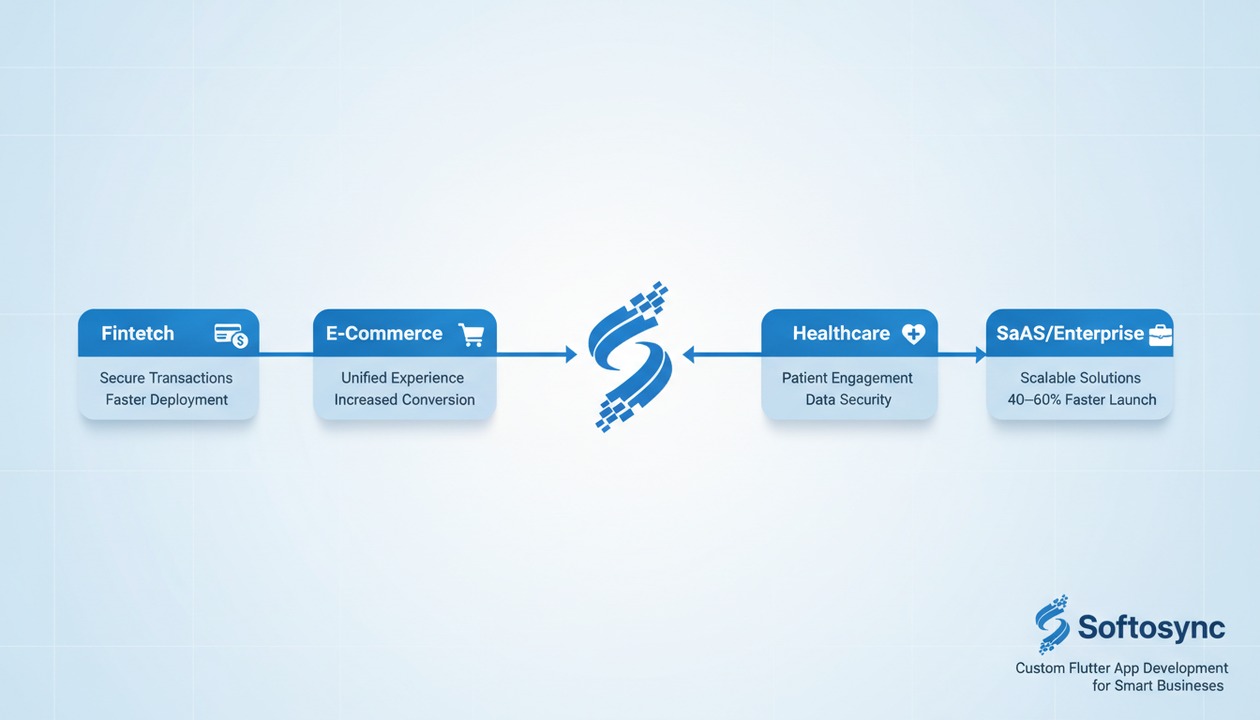
Fintech & Banking – Secure, real‑time dashboards, personalized insights and alerts, multi‑platform access for customers and agents. Companies like Nubank use Flutter to deliver banking experiences that feel more like consumer apps than traditional banking software.
E‑Commerce & On‑Demand Services – High‑performance product browsing, smooth checkout and payment flows, rich, animated UX to drive conversion. When you're competing with Amazon's mobile experience, you need every advantage you can get.
Healthcare & Wellness – Appointment and telehealth apps, remote monitoring dashboards, HIPAA/GDPR aligned experiences. The pandemic proved that healthcare apps aren't nice-to-haves anymore – they're essential infrastructure.
SaaS & Internal Business Tools – Admin and analytics dashboards, workforce, logistics, or inventory tools, custom workflow automation front‑ends. These might not be consumer-facing, but they can dramatically impact productivity and employee satisfaction.
Industry reports confirm that Flutter is widely adopted across fintech, healthcare, e‑commerce, SaaS, and education, due to its speed and cross‑platform reach.
What Does Custom Flutter App Development Actually Look Like?
Here's a simplified, practical roadmap you can expect when building a custom Flutter app with a professional team.
Discovery & Strategy – Clarify business goals and success metrics, map user personas and journeys, identify key features for MVP versus later phases, decide platforms: mobile only, or mobile plus web/desktop. This is where you define "Why are we building this?" before asking "What should we build?"
UX/UI Design – Wireframes for core flows (onboarding, main tasks, payment, etc.), visual design system: colors, typography, components, interactive prototypes for testing with real users or stakeholders, accessibility and localization considerations baked in early.
Architecture & Technical Foundations – Choose state management, modularization, and navigation patterns. Define API contracts, data models, and offline support. Plan for security: auth, encryption, compliance, logging. Decide how to integrate AI, analytics, payments, and other services.
For technical leaders, resources like "Flutter's Architecture Problem: How I Fixed My Messy Codebase" and "Stop Googling: Flutter Solutions That Actually Work" can be useful next reads.
Incremental Development – Build in sprints with prioritised user stories, use Hot Reload for rapid UI and logic iteration, continuously test: unit, widget, and integration tests, regular stakeholder demos to keep alignment.
Testing, Hardening & Launch – Cross‑device and cross‑platform QA, security and performance optimization, app store preparations, analytics setup, and crash monitoring, phased rollout (beta testers, staged releases).
Post‑Launch Improvement – Analyze real usage and drop‑off points, iterate on UX and features, scale infrastructure and add advanced capabilities like AI and automation over time.
Best Practices for Getting Real ROI from Custom Flutter Apps
Start With a Focused MVP
Resist the urge to build a "mini super app" on day one. Instead, prioritize 1–2 mission‑critical journeys, define clear KPIs (activation rate, conversion, retention, etc.), and release fast, learn faster, then scale.
I've seen too many teams spend 18 months building the "perfect" app only to discover users wanted something completely differnet. Start small, ship fast, learn constantly.
Architect for Scale From Day One
Even a small app can turn into a tangled mess if you ignore structure. Use clean, layered architecture (presentation, domain, data). Standardize state management patterns (e.g., BLoC, Riverpod, etc.). Separate feature modules for clearer ownership and easier scaling.
Here, articles like "Flutter App Development: 5 Mistakes Costing You Time" are directly relevant as cautionary tales.
Optimize Performance Early
Don't wait until the end to tune performance. Profile builds regularly. Avoid unnecessary rebuilds and over‑rendering. Manage images, animations, and network calls carefully. Test on low‑end devices and bad networks.
Integrate Analytics and Feedback Loops
Your custom mobile app development strategy should be data‑driven. Track funnels (onboarding → first action → repeat use). Capture in‑app feedback and bug reports. Use feature flags for A/B testing new flows.
Align App Roadmap with Business Roadmap
Your app is not a side project; it's part of your product and revenue strategy. Tie app features to business objectives (upsell, retention, efficiency). Review feature backlog with business stakeholders, not just dev teams. Plan releases around marketing and growth initiatives.
When Is Custom Flutter App Development the Right Move?
It's a Strong Fit If:
- You need both iOS and Android, and possibly web/desktop
- You want strong branding and UX, not just a functional shell
- You care about time‑to‑market and cost efficiency
- You foresee AI, automation, or complex workflows in your roadmap
- You want a tech stack that will still be relevant and evolving in 3–5 years
It Might Not Be Ideal If:
- You are building a deeply OS‑specific, hardware‑intensive app (e.g., very low‑level AR/VR, specialized system services)
- You only need a tiny, single‑platform internal tool with almost no UX needs
- You have an existing, mature native codebase that you're unwilling to touch
Key Takeaways for Business Leaders
Flutter is now the leading cross‑platform framework, with ~45–46% market share and strong enterprise adoption. Custom Flutter app development combines single‑codebase efficiency with fully tailored UX, workflows, and integrations. Businesses routinely see 30–40% lower development costs and 40–60% faster launch compared to building seperate native apps.
Flutter is AI‑ready, future‑proof, and ideal for super apps, foldables, and multi‑platform products. If your next strategic move involves modernizing your mobile presence, launching a new digital product, or unifying fragmented experiences into one coherent app, custom Flutter development is one of the smartest bets you can make.
The question isn't whether Flutter will be relevant in 2026 – it already is. The question is whether you'll be using it to build something that matters.