Flutter App Development: 5 Mistakes Costing You Time

Intro — the quick take
Mobile apps remain a high-growth channel, with global app downloads and consumer spending surging and AI-enabled apps expanding rapidly; startups that pick Flutter can move fast, but five recurring mistakes waste months of development time and increase costs. Tekrevol 2025 Global App Market Report[4] TST Technology 2025 statistics roundup[8]
Why this matters for startups
Startups need speed, predictable budgets, and a path to scale. Flutter promises faster cross-platform delivery and lower costs versus separate native builds, but misuse or poor processes erode those advantages—turning an "app" into months of rework and missed market windows. NetSetSoftware Flutter 2025 analysis[3]
H3: Mistake 1 — Skipping product/UX validation before building (cost: wasted dev sprints)
Why this is deadly
Startups commonly jump into building an app—including a Flutter app—before validating the problem, target flows, or core metrics. That leads to feature rework, rewrites, and lost time to market. Research shows user acquisition and retention are harder than ever; front-loading validation reduces downstream costs.TST Technology market insights[8]
How to avoid it — step-by-step
- Run a 2-week discovery sprint:
- Map core user journeys (2–3 personas).
- Prioritize an MVP feature set (use MoSCoW).
- Validate with prototypes:
- Create mid-fidelity clickable prototypes (Figma).
- Test with 10–20 target users; capture qualitative feedback.
- Measure before you code:
- Define 3 success metrics (activation, retention day-7, conversion).
- Only then convert validated screens to Flutter widgets.
Real example
A startup that validated its checkout flow reduced scope by 45% and cut 3 months of dev time by shipping a focused MVP.
H3: Mistake 2 — Treating Flutter like a silver bullet for architecture problems
The misconception
Flutter speeds UI development, but it's not a replacement for sound app architecture or separated concerns. Poor state management and monolithic code cause technical debt that slows teams down later.Redwerk pros/cons of Flutter[13]
Common anti-patterns
- Massive StatefulWidgets with UI + business logic tangled.
- Single-file controllers with hundreds of lines.
- Ad-hoc state updates that bypass testable flows.
Best practices (practical checklist)
- Choose an explicit architecture: BLoC, Provider, Riverpod, or Clean Architecture depending on team skillset.
- Enforce modular packages: split features into packages for reusability and independent testing.
- Write tests early: unit tests for business logic, widget tests for key screens.
- CI gating: require tests to pass before merging.
Internal link: For patterns and fixes, see "Stop Building Slow Apps: The Real Flutter Performance Guide" and "My Flutter App Was a Mess Until I Fixed These 4 Things".
- Stop Building Slow Apps: The Real Flutter Performance GuideStop Building Slow Apps
- My Flutter App Was a Mess Until I Fixed These 4 ThingsFlutter fixes
Quote
"Flutter accelerates UI delivery—but speed without structure becomes technical debt." — industry engineering lead
H3: Mistake 3 — Ignoring platform-specific performance and size optimizations
Why startups lose time
Large app bundles and slow hot paths create poor first impressions and high uninstall rates. Users expect native-like speed and modest download sizes.NetSetSoftware Flutter growth & performance claims[3]
Performance checklist
- Reduce initial app size:
- Use deferred components & split AOT bundles for Android.
- Tree-shake unused Dart code and remove unused assets.
- Optimize rendering:
- Avoid rebuilds with const constructors and keys.
- Profile with Flutter DevTools and trace raster threads.
- Network & startup:
- Lazy-load heavy modules.
- Use code obfuscation and shrinkers cautiously.
Quick wins (actionable)
- Run flutter build apk –release and inspect size tree.
- Use deferred imports for non-core features.
- Profile cold start and fix expensive synchronous init calls.
H3: Mistake 4 — Weak CI/CD, testing, and release processes
The cost
Manual builds, infrequent releases, and missing telemetry extend the time to catch regressions and ship fixes. In a competitive app market projected to exceed billions in consumer spending, continuous delivery is a must.Itransition mobile app market insights 2025[6]
What to implement now (practical steps)
- Automated pipelines:
- Build → test → code signing → publish to beta channels (using GitHub Actions, Bitrise, or Codemagic).
- Phased rollouts:
- Canary releases and staged rollouts reduce blast radius.
- Observability:
- Integrate crash reporting (Sentry/Firebase Crashlytics) and performance monitoring.
- Test matrix:
- Unit tests, widget tests, integration tests with Firebase Test Lab or BrowserStack.
Actionable template (example GitHub Actions job)
- Trigger: pull_request & push to main.
- Steps: checkout → set up Flutter → run dart analyze → run unit tests → build APK/IPA → upload artifacts.
Internal link: Related reading — "Flutter App Development: Avoid These Costly Mistakes".
- Flutter App Development: Avoid These Costly MistakesFlutter mistakes
H3: Mistake 5 — Overbuilding features instead of optimizing for retention and growth
Why it’s expensive
Startups often equate "more features" with product-market fit. Data shows retention and engagement are driven by a few high-value flows; building everything dilutes focus and wastes engineering cycles.TST Technology 2025 stats — engagement & AI growth[8]
How to prioritize for growth
- Use Pirate Metrics (AARRR):
- Acquisition, Activation, Retention, Referral, Revenue.
- Choose retention-driving features first:
- Example: push personalization, onboarding improvements, and performance fixes.
- Run rapid experiments:
- Launch an A/B test with Firebase Remote Config or server-side toggles.
Real-world example
Companies that invested in optimizing onboarding and push personalization saw retention lift that justified additional investment in product features.
Comparison table — Common mistakes vs. cost to startup (time & money)
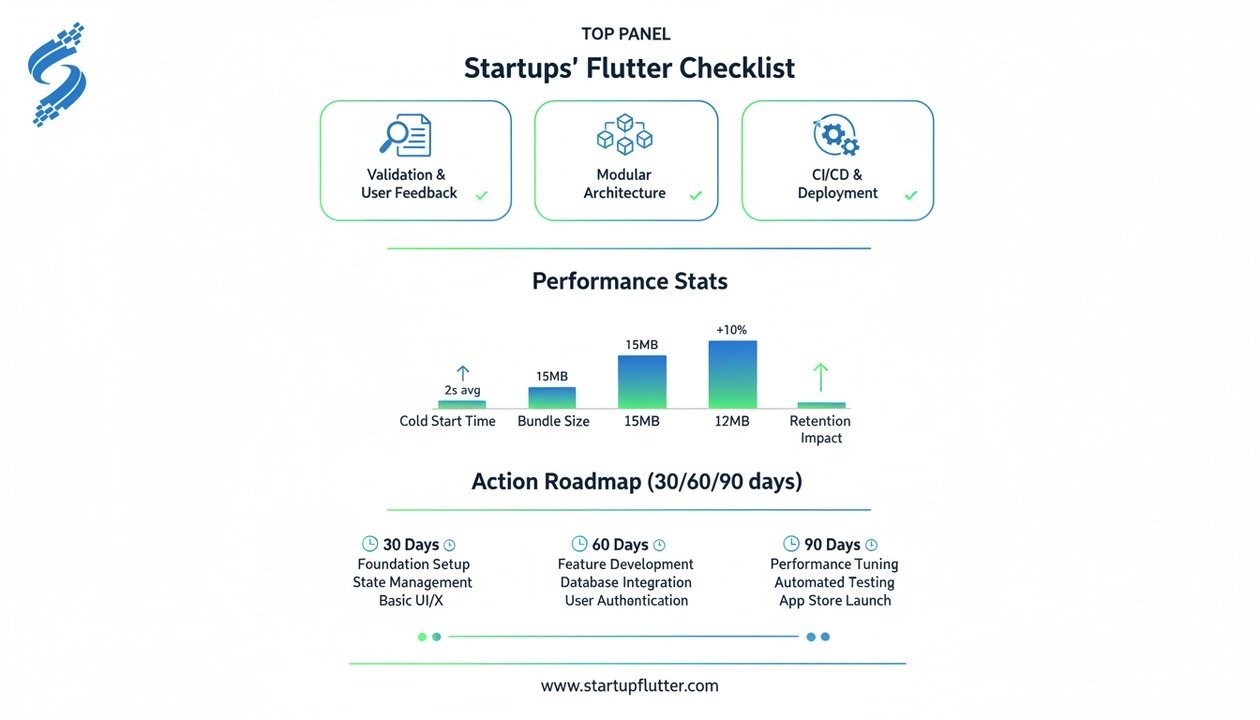
H4: Quick audit checklist for startups (one-page actionable)
- Product: Do we have validated user journeys? Yes/No
- Architecture: Is logic separated from UI (feature packages)? Yes/No
- Performance: Cold-start under 2s? App size under target? Yes/No
- CI/CD: Automated build + tests on PR? Yes/No
- Metrics: Crash rate < 1% and D7 retention tracked? Yes/No
If more than two "No", prioritize fixes in the next sprint.
Expert voices & recent evidence
- Flutter adoption and performance gains: multiple 2024–2025 industry reports show strong Flutter usage among cross-platform projects and measurable speed-to-market benefits for teams that adopt structured workflows.GoodFirms Flutter 2025 overview[1]
- Market context: global app downloads and spending continue to grow—meaning faster time-to-market improves chances of traction.Tekrevol global app market & download projections 2025[4]
- Trend signals: AI-enabled apps and modular architectures are high-growth categories; startups should design for incremental feature delivery and observability early.TST Technology mobile app stats 2025[8]
Blockquote
"Move fast—but structure faster: validated scope, modular code, and automated release pipelines are what turn Flutter's speed into sustainable advantage." — Senior mobile engineering leader
Practical rollout plan (30/60/90 days) — for a lean startup Flutter app
30 days
- Run discovery & prototype tests; finalize MVP scope.
- Create skeleton Flutter project with modular packages.
- Set up CI: linting and unit tests on PRs.
60 days
- Implement core flows, integrate crash & analytics.
- Run performance profiling; fix top 3 cold-start/size issues.
- Deploy closed beta via staged rollout.
90 days
- Iterate on retention features (onboarding, notifications).
- Add automated integration tests and expand device matrix.
- Move to public staged rollout and measure AARRR metrics.
Actionable tips — avoid common traps today
- Start with metrics, not features. Focus on activation and retention.
- Treat Flutter codebase like any multi-platform product: enforce modularity.
- Automate everything: builds, tests, and staged rollouts.
- Profile early: performance fixes are cheaper before feature lock-in.
- Use feature flags for experiments and graceful rollbacks.
Internal resources to help your team
- "Stop Building Slow Apps: The Real Flutter Performance Guide" — practical perf fixes.Stop Building Slow Apps
- "My Flutter App Was a Mess Until I Fixed These 4 Things" — refactor case study.Flutter fixes
- "Flutter App Development: Avoid These Costly Mistakes" — complementary checklist.Flutter mistakes
Conclusion — what to do next
Startups that leverage Flutter correctly can ship faster and conserve runway—but only if they validate early, enforce modular architecture, optimize performance, automate releases, and prioritize retention-driving features. Begin with the 30/60/90 plan above, run the one-page audit, and fix the top two gaps this sprint to reclaim weeks (or months) of wasted time.
Call to action
If you want, run a quick audit of your current Flutter codebase and release process—identify the two highest-impact fixes and schedule them into your next sprint. Need help? Check our mobile app development services for tailored audits and execution.Mobile App Development service
Forward-looking note
As 2025 proceeds, Flutter will remain a powerful tool for startups—those who combine it with disciplined product and engineering practices will capture market windows faster and at lower cost.