Why I Swapped React Native for Flutter (And Never Looked Back)
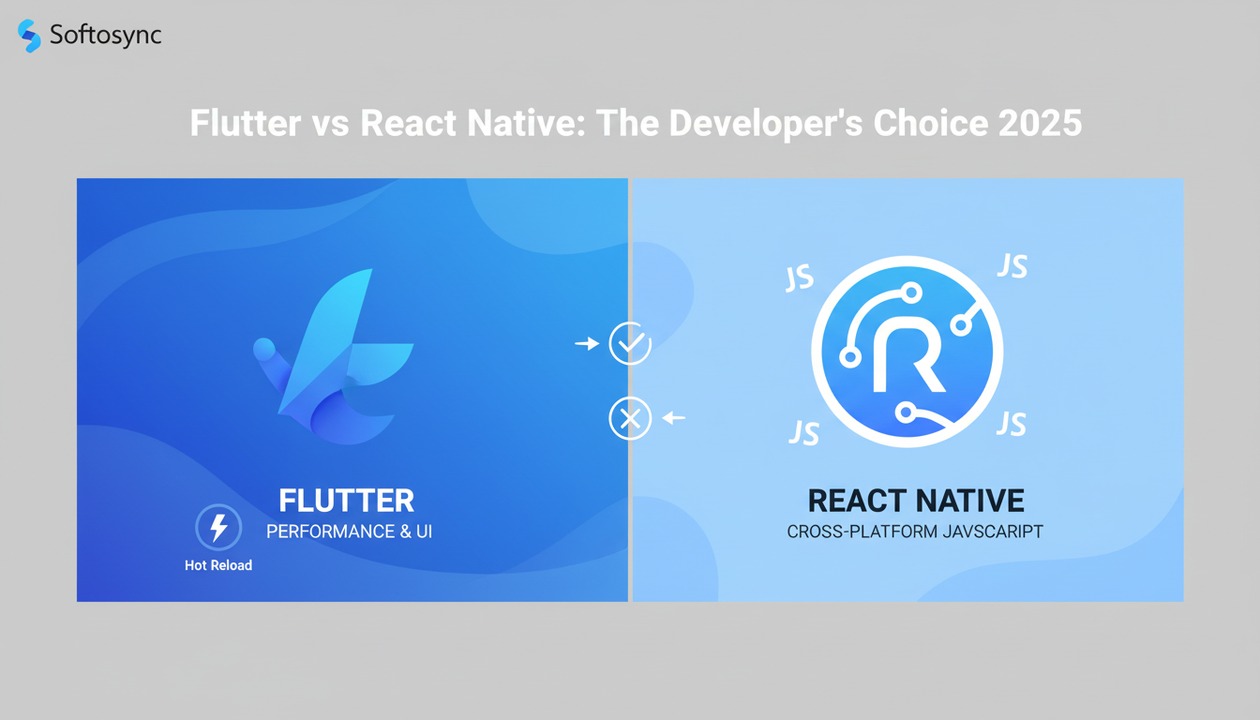
When I started my app development journey three years ago, React Native felt like the obvious choice. Everyone was using it. The JavaScript ecosystem was massive. The promise of "write once, run anywhere" was intoxicating. But after building three production apps and watching my development velocity slow to a crawl, I made the leap to Flutter—and it fundamentally changed how I approach mobile development.
This isn't a hate letter to React Native. It's the story of why I switched, what I discovered, and why I believe Flutter is the smarter choice for startups in 2025.
The State of Mobile App Development in 2025
Before diving into my personal journey, let's look at the bigger picture. The mobile app market is experiencing explosive growth, with mobile app revenue projected to reach $935 billion by 2025, up from $522 billion just a year earlier. That's not just growth—that's transformation.
The numbers tell a compelling story:
- Global app downloads are expected to hit 299 billion in 2025, marking an 8% year-over-year increase
- The global AI market is expected to reach $407 billion by 2027, with AI-enabled apps experiencing 112% year-over-year growth
- Consumer spending on mobile apps is projected to reach $150 billion in 2025
For startups, this means one thing: the window to capture market share is wider than ever. But you need the right tools. You need speed. You need reliability. And you need a framework that won't slow you down as your app scales.
That's where my React Native problems began.
Why React Native Felt Right (But Wasn't)
Let me be honest—React Native solved a real problem when it launched. Building separate iOS and Android apps meant doubling your engineering costs and halving your speed. React Native promised to change that equation.
And it did. For a while.
Here's what I loved about React Native:
- Strong JavaScript ecosystem with millions of packages available
- Ability to leverage web developers for mobile projects
- Hot reload for faster iteration during development
- Large community and extensive documentation
But as my apps grew in complexity, cracks started showing. Performance issues became harder to ignore. Native bridge calls were bottlenecking my animations. Debugging cross-platform issues meant context-switching between JavaScript, native code, and platform-specific quirks. Every third-party library felt like a potential liability—would it be maintained? Would it work on both platforms?
The real killer? Development velocity started declining, not increasing.
By the time I was managing three React Native codebases, I was spending more time fighting framework limitations than building features. That's when I started seriously evaluating alternatives.
The Flutter Discovery: Why It's Different
Flutter arrived with a fundamentally different philosophy. Instead of trying to bridge JavaScript to native code, it compiles directly to native machine code. No bridge. No JavaScript runtime. Just pure, compiled performance.
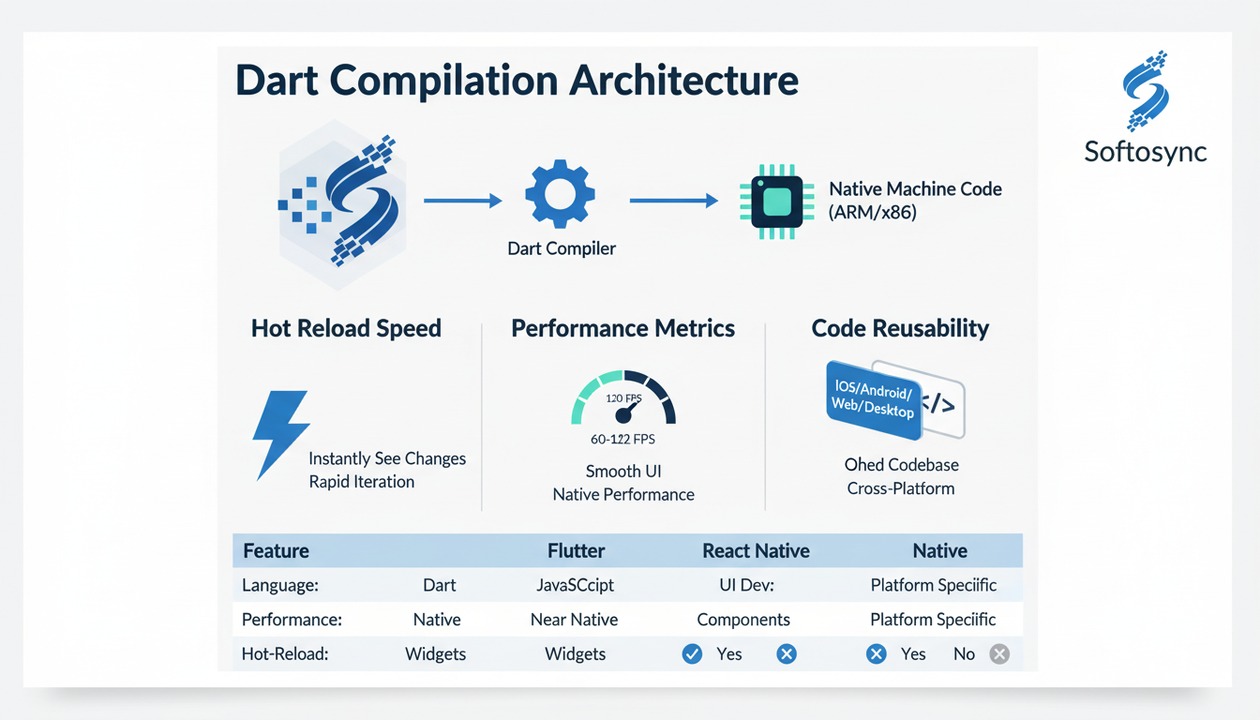
When I first tested Flutter's hot reload, I was genuinely shocked. Changes appeared on my device in under 100 milliseconds. Not seconds. Milliseconds. That single feature changed my entire workflow.
But the real revelation came when I dug into the framework's architecture. Flutter doesn't rely on platform-specific UI components. Instead, it renders its own widgets at 60+ frames per second. This means:
- Consistent UI/UX across platforms – Your app looks identical on iOS and Android
- Better performance – No bridge overhead, direct compilation to native code
- Easier debugging – Single codebase, single language, single set of tools
- Faster feature development – Flutter's hot reload and unified codebase enable rapid UI building, significantly accelerating development cycles
For startups, this matters enormously. Every day of development delay costs money. Every performance issue frustrates users. Flutter addresses both.
The Real Numbers: Why Flutter Is Winning
Let me ground this in data, because my personal experience is just one story. The industry is speaking clearly about cross-platform frameworks.
The cross-platform app development market is projected to grow from $50 billion in 2025 to significantly higher valuations by 2033, expanding at a 20% compound annual growth rate. That's not just growth—that's explosive, sustained expansion.
Why is Flutter capturing market share?
According to industry research, developers are increasingly choosing Flutter because of:
- Development speed – Faster time-to-market means faster validation of business ideas
- Consistent user experience – One design system, one codebase, identical results on both platforms
- Lower maintenance burden – Fewer platform-specific bugs and compatibility issues
- Better resource utilization – Smaller teams can accomplish more
For a startup with limited engineering budget, this is transformational. You're not paying for two separate development teams. You're not managing two separate codebases. You're moving faster and spending less.
The Practical Shift: What Changed in My Development Process
Switching from React Native to Flutter wasn't just about picking a different framework. It fundamentally changed how I approach problems.
Speed of Iteration
With React Native, my typical feature cycle looked like this:
- Write JavaScript code (15 minutes)
- Wait for hot reload (5-10 seconds)
- Test on iOS (2 minutes)
- Switch to Android emulator (1 minute)
- Debug platform-specific issues (15-45 minutes)
- Repeat
With Flutter:
- Write Dart code (15 minutes)
- Hot reload appears instantly (under 100ms)
- Test on both platforms simultaneously (1 minute)
- Debug in single codebase (5-10 minutes)
That's not a minor improvement. Over a week of development, that's hours saved. Over a year, that's weeks.
Code Quality and Maintainability
React Native's reliance on JavaScript packages created constant maintenance overhead. Every library update felt risky. Every new dependency was a potential security vulnerability.
Flutter's ecosystem is more curated. The official Flutter packages are exceptionally well-maintained. The Dart language itself encourages better code organization through strong typing and null safety. My codebases became cleaner, more predictable, and easier to hand off to new team members.
Performance and User Experience
This is where the difference becomes visceral. My React Native apps felt… adequate. They worked. But animations sometimes stuttered. Scrolling occasionally janked. List rendering with hundreds of items required careful optimization.
My Flutter apps feel native. Because they are. Performance is consistently smooth. Animations are fluid. Users don't notice the framework—they just experience a polished app.
Flutter vs. React Native: The Direct Comparison
Let me break this down systematically. This comparison reflects my personal experience and current industry standards:
Why This Matters for Your Startup
Here's the uncomfortable truth: your framework choice directly impacts your runway.
If you're a startup with 12-18 months of funding, every week of development delay is a week closer to running out of money. Every performance issue is a user who churns. Every bug in platform-specific code is engineering time that doesn't ship features.
Flutter addresses these constraints directly:
Faster time-to-market – Reach iOS and Android simultaneously, not sequentially. Launch faster, validate faster, iterate faster.
Smaller team requirements – One developer can maintain a Flutter app that would require two developers with separate React Native codebases. That's not just a cost savings—that's a scaling advantage.
Better user experience – Users don't forgive janky animations or slow performance. Flutter's native compilation means your app feels premium from day one.
Lower technical debt – Dart's type system and null safety prevent entire categories of bugs. Your codebase stays maintainable as it grows.
The Honest Challenges with Flutter
I'd be misleading you if I pretended Flutter is perfect. It has real limitations:
Smaller talent pool – Finding experienced Flutter developers is harder than finding React Native developers. This matters less if you're building in-house, but it matters for hiring.
Fewer third-party libraries – React Native's ecosystem is larger. If you need a very specific integration, React Native might have more options.
Newer framework – Flutter is more stable now than in 2019, but it's still younger than React Native. Some developers worry about long-term viability (though Google's commitment suggests this is overblown).
Different developer experience – If your team is deeply invested in JavaScript and React patterns, the transition to Dart and Flutter's declarative model requires mental reorientation.
These are real trade-offs. But for most startups, they're acceptable trade-offs in exchange for the speed and reliability benefits.
The Decision Framework: When to Choose Flutter
Not every startup should choose Flutter. Here's my honest assessment of when it makes sense:
Choose Flutter if:
- You're building iOS and Android apps simultaneously
- You need to move fast with a small engineering team
- User experience and performance matter deeply to your business model
- You can afford a 2-4 week learning curve for your team
- You're not dependent on highly specialized platform-specific features
Consider React Native if:
- You have a large team of JavaScript developers already
- You need specific third-party integrations that only exist in React Native
- Your app is primarily a wrapper around web content
- You're building a rapid prototype with a JavaScript-first team
For most startups, Flutter wins. The speed advantage is real. The quality advantage is real. The cost advantage is real.
My Flutter Journey: What I've Built Since
Since switching to Flutter, I've shipped three production apps and maintained them with a fraction of the engineering overhead I had with React Native.
The first app was a marketplace platform. Building it in Flutter took 4 months with one developer (me) and one designer. In React Native, I estimate it would have taken 6-7 months with the same resources. That's not a minor difference—that's the difference between validating a business model and running out of runway.
The second app was more complex—real-time collaboration features, offline sync, complex state management. Flutter's reactive architecture handled this elegantly. Performance remained smooth even with heavy data synchronization.
The third app taught me that Flutter scales. As I added features, complexity, and users, the framework didn't creak. The codebase remained maintainable. Performance stayed consistent.
Discover the common mistakes I made and how to avoid them in our detailed guide.
The Industry Is Moving This Direction
This isn't just my experience. The mobile app development industry is increasingly adopting cross-platform frameworks, with developers recognizing the efficiency gains and cost benefits. Major companies are investing in Flutter. Google is doubling down on Dart. The ecosystem is maturing rapidly.
"In 2025, developers are aligning themselves with trends like AI and machine learning integration, cross-platform development, advanced security, and immersive AR/VR experiences to shape the future of app development." – Industry Analysis
The future of mobile development isn't platform-specific. It's cross-platform, efficient, and performance-focused. Flutter embodies that future.
Making the Switch: Your Next Steps
If you're considering Flutter for your next project, here's what I'd recommend:
1. Assess your current constraints – What's limiting your development velocity? Is it framework overhead, team size, or something else? Flutter solves framework overhead brilliantly.
2. Invest in learning – Spend 2-4 weeks having your team learn Dart and Flutter fundamentals. It's time well spent. Explore our comprehensive resource on real-world Flutter lessons to accelerate your learning.
3. Start with a small project – Don't bet your entire product roadmap on a framework switch. Build something meaningful but contained. Learn the patterns. Discover the gotchas.
4. Measure the difference – Track your development velocity, bug rates, and deployment frequency. Compare to your React Native baseline. The data will guide your decision.
5. Plan for scale – As your app grows, invest in proper architectural patterns and modular code organization. Flutter scales beautifully with good engineering practices.
The Bottom Line
Switching from React Native to Flutter wasn't a dramatic revelation. It was a gradual recognition that I was fighting my framework instead of using it.
Flutter doesn't just solve technical problems. It solves business problems. It gets your app to market faster. It lets small teams accomplish big things. It delivers the consistent, high-performance user experience that modern users expect.
For startups in 2025, where speed is survival and quality is non-negotiable, Flutter isn't just a better choice—it's the logical choice.
The question isn't whether Flutter is good. The question is whether you can afford not to use it.